OhioHealth Physician Group Earns Three American Heart Association Awards for Heart Health Care
Key Takeaways:
- Three national honors: OhioHealth Physician Group earned three American Heart Association Outpace CVD awards for blood pressure, diabetes and cholesterol care.
- Team-based care: The awards reflect a team-based chronic disease care model, with collaboration across primary care, cardiology, endocrinology, population health and care management teams.
- Continued focus: This is not the first year OhioHealth has earned similar recognition. Maintaining this level of performance takes continued focus and effort from a multifaceted team.
OhioHealth Physician Group has been recognized by the American Heart Association with the highest level of achievement in three national quality programs focused on blood pressure, diabetes and cholesterol management.
OhioHealth Physician Group again earned three recognitions through the 2026 Outpace CVD awards:
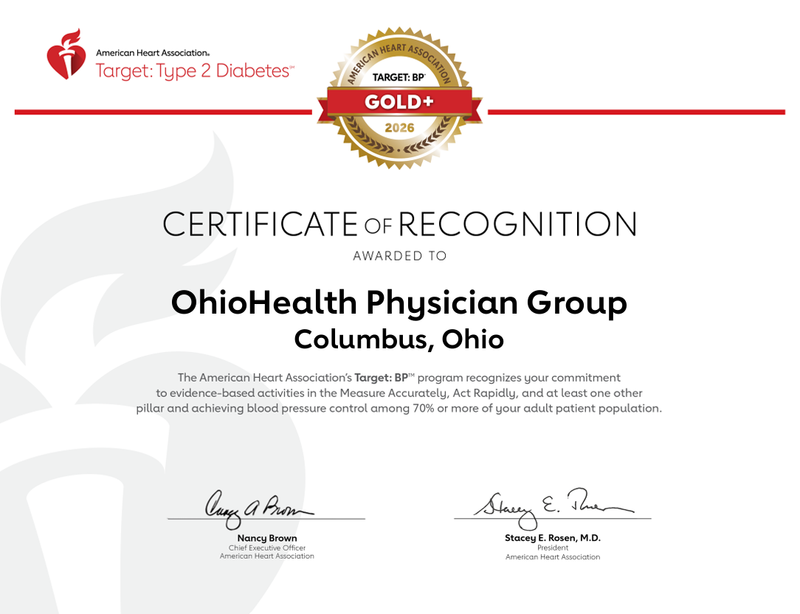
- GOLD+ for Target: BP™: Supports health care organizations in improving blood pressure control through evidence-based quality improvement, including accurate measurement and evidence-based treatment.
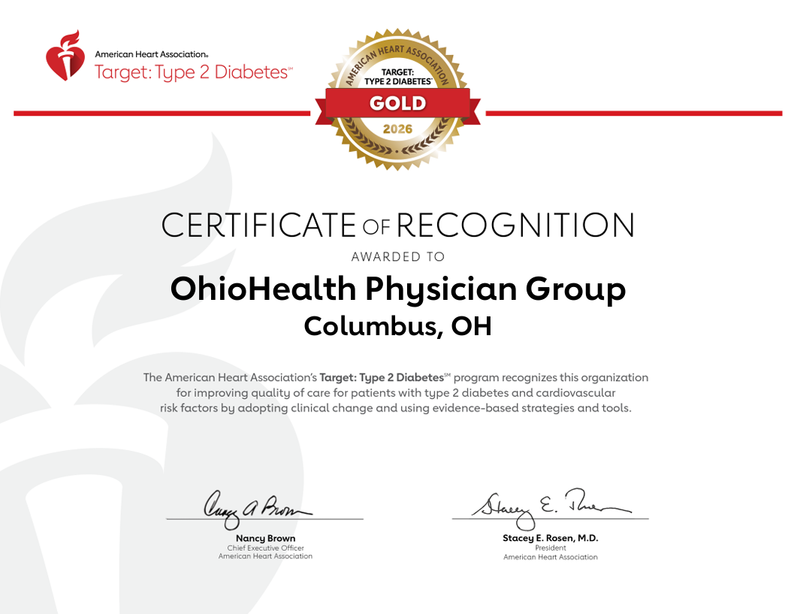
- GOLD for Target: Type 2 Diabetes℠: Helps health care organizations identify and address cardiovascular risk factors among people with Type 2 diabetes through evidence-based quality improvement tools and clinical resources.
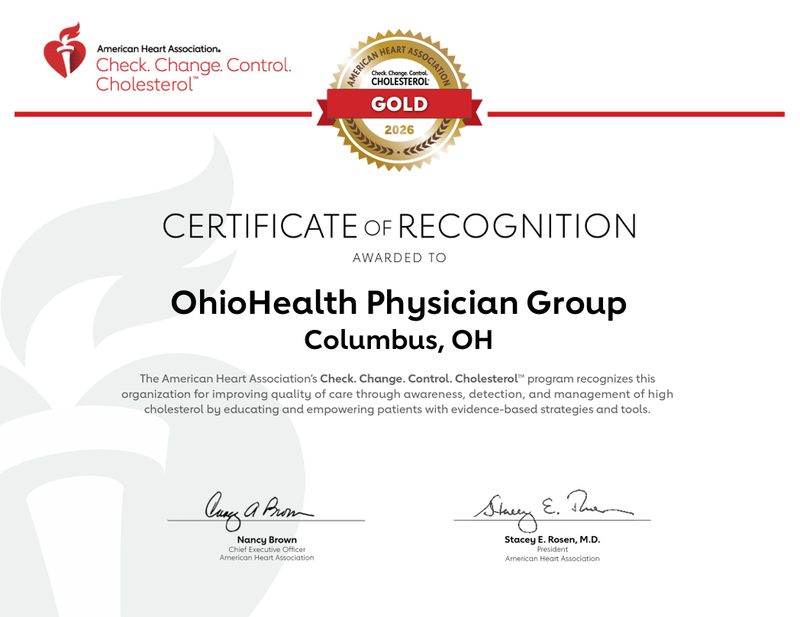
- GOLD for Check. Change. Control. Cholesterol™: Provides tools and resources to support awareness, detection and guideline-based management of high cholesterol.
The recognition reflects consistent use of evidence-based care and strong patient outcomes. It also demonstrates collaboration across primary care, cardiology, endocrinology, population health and care management teams.
“These awards are only the tip of the iceberg of all the work OhioHealth is doing across the organization to strive to provide every single patient with state of the art, high quality care,” Mariah Barlow, MD, Associate Program Director OhioHealth Riverside Methodist Hospital Internal Medicine Residency Program, Medical Director Quality and Patient Safety, said. “This represents the continued mission to improve the health of our communities.”
Across all three programs, the strategy that makes the biggest difference in helping patients gain control of these conditions is engaging the patient.
“Our goal is to help them to understand their health & disease & empower them with the knowledge and the tools they need to be an active participant in their healthcare, while ensuring equitable access to the tools, resources and providers necessary to do so,” Dr. Barlow said.
The work directly affects patients’ long-term health.
“In the United States, cardiovascular disease remains the leading cause of death. Diabetes, high cholesterol and hypertension are three of the leading risk factors for cardiovascular disease,” Dr. Barlow said. “Management of these allows patients to prevent long-term cardiovascular complications, while also allowing them to live longer, healthier lives.”
According to the Heart Association, more than 39 million U.S. adults are living with diagnosed or undiagnosed diabetes, and cardiovascular disease remains a leading health threat for people with Type 2 diabetes. Timely diagnosis, evidence-based treatment, and long-term management of cardiovascular risk factors can help reduce cardiovascular risk and support better health.
To earn the awards, a representative from OhioHealth submits data from across the health system to the American Heart Association’s platform. The data includes demographic information, patient numbers, patient interactions, blood pressure measurements and follow-up when a patient has high blood pressure. The awards are given for meeting targets set by the Heart Association. OhioHealth also attests to a series of evidence-based activities that the Heart Association and others identify as strategies for improving these measures. OhioHealth is exceeding expectations.
This is not the first year OhioHealth has earned similar recognition.
“Maintaining this level of performance isn’t easy. Some people believe it may be harder to maintain a result than even achieve it,” Dr. Barlow said. “It takes continued focus and effort from a multifaceted team who is continuously and intentionally reviewing how we provide care for these disease states. We strive every day to leverage new technology with guidance from subject matter experts – both clinical and nonclinical – to continue to stay up to date in providing evidence-based care.”
From a diabetes perspective, the recognition shows OhioHealth is providing consistent, proactive care instead of waiting for diabetes to become uncontrolled or for complications to develop.
“Our focus has been on identifying patients who need testing or additional support, making it easier to complete that care, and acting on results earlier,” Kimberly Austin, MD, FAAFP, Medical Director of Quality and Patient Safety, said. “We are focused on increasingly using every patient interaction as an opportunity to understand how their diabetes is doing and connect them with the right resources.
Ultimately, the awards reflect thousands of individual interactions between patients and their physicians, advanced practice providers, nurses, medical assistants, pharmacists, care managers and other members of the care team.
A key change in this work was moving away from relying solely on physicians. Care teams now identify open care gaps before a visit, perform A1c tests during appointments, contact overdue patients and refer those who need more help to pharmacy or care management. Wellness coordinators, nurses, pharmacists and primary care providers work together on the standardized A1c process.
“That means the physician is still leading the clinical decision-making, but the entire team is helping make sure the physician has the information and resources needed to act,” Dr. Austin said.
OhioHealth also added bulk ordering to reduce missed tests. Follow-up now happens sooner as a patient’s A1c rises, and pharmacy diabetes-management support is recommended when A1c reaches 9% or greater.
“It is not simply ‘Did we check an A1c?’ It is ‘Do we know how this patient is doing, and if they aren’t doing well, what are we going to do next?’” Dr. Austin said.
For patients, better diabetes care means finding worsening blood sugar earlier, while there is still time to intervene before complications develop. The work also looks beyond A1c to kidney health and diabetic eye disease.
“Good diabetes care is ultimately about protecting the whole patient,” Dr. Austin said. “It isn’t simply moving someone into the numerator. It is giving a patient the support, information and treatment they need to change their health trajectory.”
Keeping up that performance means reviewing results at the practice and patient level, working with practices on barriers and building more reliable workflows, including for diabetic eye exams and kidney screening. It also takes constant attention, because patient populations change and workflows can drift.
“That’s why our emphasis increasingly is on building diabetes care into standard work so that high-quality care doesn’t depend on a single person remembering to do the right thing at the right time,” Dr. Austin said. “The award is wonderful recognition, but our real measure of success is whether those processes continue working for the next patient who walks through the door.”
“We are lucky at OhioHealth to be able to implement a team-based chronic disease care model that leverages resources to meet patients where they are; providing individualized care for every patient,” Dr. Barlow said. “This work and these outcomes are not possible without the contributions of our care managers, pharmacists, social workers, community health workers, dieticians and office staff who all work together with a patient and their provider to achieve optimum results.”