

Patient Overcomes Unexpected Heart Failure Diagnosis Through High-Quality Care and Treatment
In late 2023, Samantha Smith was referred to Tejas Mehta, MD, interventional cardiologist at OhioHealth, who ordered her an echocardiogram. In December 2023, Smith was diagnosed with heart failure, and in January 2024, she was hospitalized at OhioHealth Riverside Methodist Hospital due to a heart failure exacerbation, where she began seeing Katherine Dodd, DO, OhioHealth heart failure and transplant cardiologist.
“An echocardiogram or ultrasound of the heart at the time demonstrated that Sam's heart was extremely weak,” said Dr. Dodd.
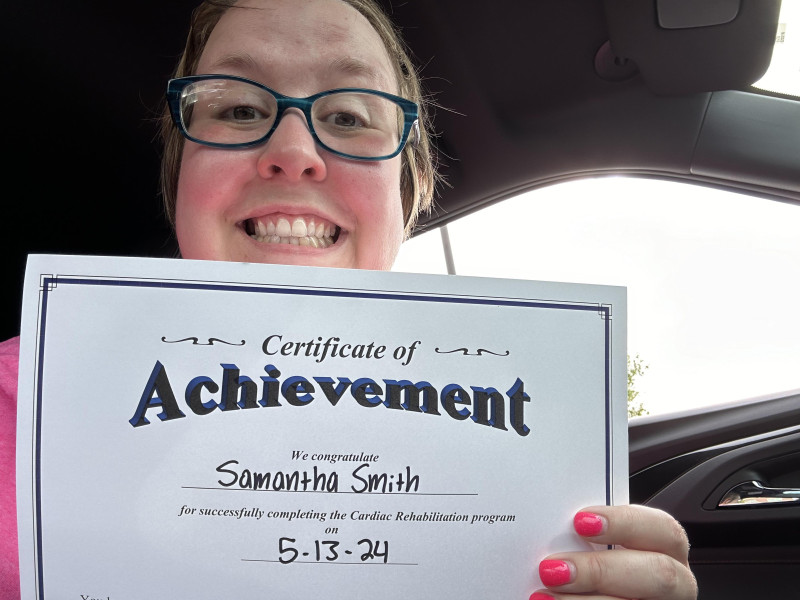 Smith previously underwent chemotherapy for breast cancer in 2020. She mentioned that one of the medications carried a very small risk of being cardiotoxic. “Some of the most common chemotherapeutic agents to treat breast cancer, unfortunately can lead to a nonischemic cardiomyopathy or weakening of the heart,” said Dr. Dodd.
In the years following treatment, she noticed her resting heart rate was consistently around 120, even while relaxing, along with frequent heart palpitations that made her feel extremely uncomfortable.
“Seeing a fast heart rate or sinus tachycardia, especially in a young patient, is an extremely ominous sign,” said Dr. Dodd. “When the heart becomes extremely weak, it cannot keep up with delivering blood and oxygen to the body. Therefore, the brain sends a signal to the heart to increase the speed at which it is beating in an attempt to increase the cardiac output.”
The OhioHealth care team at OhioHealth Riverside Methodist Hospital worked through a process of elimination to determine the cause, with the understanding that the most likely cause of Smith’s heart failure was toxin induced from the chemotherapy she had received previously to treat her breast cancer.
Dr. Dodd ordered genetic testing to rule out any family or inherited component. While in the hospital in January of 2024, she underwent a heart catheterization to check for plaque or underlying coronary artery disease as what we termed "ischemic cardiomyopathy" or weakening of the heart due to lack of oxygen or blood flow to the heart is one of the primary and most common causes of heart failure.
Smith also underwent a cardiac MRI to ensure there were no other underlying causes or more rare disorders. “MRIs of the heart are used quite a bit these days as they give us much more detail of the heart muscle and can give us a more accurate estimation of the heart function,” said Dr. Dodd.
Smith is now on a medication regimen that has helped significantly.
“We try to get all of our patients on the 4 pillars for heart failure or GDMT (guideline directed medical therapy),” said Dr. Dodd. “All four classes of these drugs have been shown to reduce the patient's chances of dying from heart failure or be admitted to the hospital with heart failure symptoms such as shortness of breath, abdominal bloat, weight gain, swelling in the feet and ankles, and fluid retention.
Another component of expediting heart function recovery is participating in cardiac rehab. According to Dr. Dodd, typically patients go for one-hour sessions where they are monitored by well-trained nurses and participate in supervised exercise for two to three days a week for roughly six weeks.
“We have to remember, the heart is a muscle like any other muscle in the body, and it likes to be used and conditioned,” said Dr. Dodd.
Cardiac rehab has also been shown to improve the function of the heart, and it is very important that patients try to participate in 30 minutes of some type of cardiovascular activity three to four days a week, if possible, that is a recommendation by the American Heart Association and American College of cardiology.
“Fortunately, Samantha responded to these medications beautifully and was able to tolerate all of them,” said Dr. Dodd. Her heart rate has been cut nearly in half, and she feels much better overall. Additionally, on a repeat echocardiogram, Smith’s heart function has now recovered back to normal.
However, Smith said she still has to be mindful of certain risks and triggers, including extreme heat and cold. She is also cognizant about letting her symptoms be her guide and never pushing through anything and always seek evaluation if something is off.
Throughout her journey, she turned to social media to hear from others going through similar experiences, which helped reassure her that she wasn’t alone and that she would be OK. She realized that heart failure can look different in each patient, it's not just caused by lifestyle. While risk factor modification is important and patients should eat a healthy diet and engage in routine exercise, Dr. Dodd shared that there are often other factors out of one’s control that can precipitate heart failure.
“Even in young patients, there needs to be a high index of suspicion, and heart failure should always be ruled out in patients presenting with shortness of breath, decreased exercise capacity, low blood pressure, fast heart rate, etc., even if they are quite young,” said Dr. Dodd. “In this day and age, we have ‘advanced heart failure therapies’ to offer to certain patients that do not get better with medications alone, such as mechanical heart pumps and even heart transplant.”
