

Emergency Department Staff, Paramedics Credit Swift Handoffs With Saving Lives
When every second counts, getting a stroke patient the care they need is critical. Most patients showing symptoms of a stroke are picked up by ambulance and taken to a hospital for treatment. That’s why paramedics do everything they can to move as fast as possible.
“With large vessel occlusions, for every minute it takes before the vessel gets opened, that equals one week of rehab,” said OhioHealth EMS Coordinator Zach Smith, EMT-P. “That’s always in the back of my mind, so that helps me expedite transport even faster.”
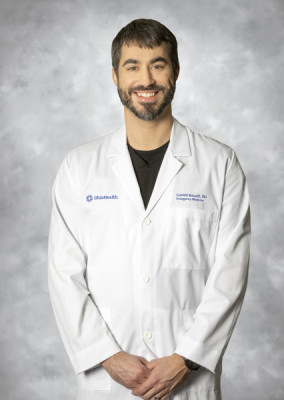 While time is of the essence, it’s not the only responsibility a paramedic has when transporting a potential stroke patient. According to Garrett Bassett DO, FACEP, medical director of OhioHealth Mansfield Hospital’s Emergency Department, many medical conditions can mimic a stroke. Some of these conditions include low blood sugar, sepsis, seizures, or migraines. Together, paramedics and the emergency physician work to evaluate for these other conditions. “Figuring out if this is a stroke, or one of these other stroke mimics, is very important,” said Dr. Bassett.
Confirming a patient is indeed having a stroke is a big part of the puzzle. Physicians can then get the patient the appropriate medical treatment they need, such as a clot-busting drug when a clot is blocking blood flow to the brain. However, depending on what medications the patient is taking, treatment can be limited. “A patient’s medical history is incredibly important,” said Dr. Bassett. “If they’re on a blood thinner, it really limits what we can do.” Patients on blood thinners can’t take clot-busting medication due to increased risk of bleeding. Many times, Dr. Bassett says emergency physicians lean on paramedics to learn the patient’s medical history. That’s why Smith gives a list of blood thinners to all paramedics he works with to help them identify whether patients are on them. It’s a small action that could make a great deal of difference down the line.
Within ten minutes of arriving at the hospital, a patient gets a CT scan to determine whether or not they have bleeding in the brain. From there, they may receive a clot-busting medication to dissolve their blood clot, depending on their risk of bleeding, or be taken to a Comprehensive Stroke Center, such as Riverside Methodist Hospital, that can remove their clot from the vessel.
While Mansfield Hospital is the only Primary Stroke Center in Richland County and its surrounding area, meaning it has the resources to manage acute stroke patients and meet their medical, recovery, and social needs, options become limited after time has passed. Dr. Bassett says after four and a half hours, treatment options are more limited. That’s why he urges anyone who thinks there’s a chance they’re having a stroke to seek medical care immediately. “Don't wait to see your doctor,” said Dr. Bassett. “And don’t wait to see if symptoms go away if you haven't. We need to know right away.”
During National Stroke Awareness Month this May, local EMS got together to discuss stroke symptoms and train on expediting transport. Smith says OhioHealth’s Stroke Network educates fire departments in Richland County and its surrounding counties to make sure paramedics can spot stroke symptoms and begin protocol as fast as possible. Smith says this training helps paramedics get patients to hospitals as fast as they can, and ultimately, save lives.
