

OhioHealth Patient Reunites With Care Teams That Saved His Life
On the morning of Dec. 14, Mark LaMonte looked outside to find snow covering the ground. He and his son went out to shovel together, then came back inside to make breakfast.
“A few seconds after that, I started to feel a strange sensation in the center of my heart, in my chest,” LaMonte said.
He turned off the stove and went to sit down in his dining room. His wife and son came into the room.
“She said to me, are you OK, and I said no something is wrong in my chest,” LaMonte said. So, she immediately called 911.
An EMS crew arrived within minutes. By then, LaMonte said the pain was intensifying and he was starting to feel lightheaded. As responders asked questions, he told them he was in pain and felt like he might faint.
“Everything went black at that point, just went totally dark.” LaMonte said.
LaMonte was taken to OhioHealth Riverside Methodist Hospital. On the way, a defibrillator was used 13 times to restore his heart rhythm, and another 27 times after he arrived - 40 times in total.
According to medical experts at Riverside Methodist, needing that many defibrillations is extremely rare. They’re calling his survival a Christmas miracle.
“There were so many things that aligned in his favor which ultimately contributed to his survival that in my mind it truly was a miracle,” John Phillips, MD, OhioHealth interventional cardiologist and surgeon. said. “And I have told him this that God has a plan for him and the plan was not for him to die during this event.”
At Riverside Methodist, LaMonte was placed on ECMO with an Abiomed Impella to vent the heart, which then allowed for two stents to be placed.
ECMO functions as the heart and lungs outside of the body. It takes the deoxygenated blood, oxygenates it, and pumps it back into the body. “We use this device to support a patient whose heart and ultimately lungs are not working for them,” Dr. Phillips said.
The Impella is also used to perform the job of pumping blood to the vital organs or at least assisting in it.
“The Impella has a little motor that sits in the pumping chamber of the heart and takes that blood and expels it,” Dr. Phillips said. “Those devices gave us time to understand ultimately what caused his cardiovascular collapse, blocked arteries, for which we were able to open them and deploy the stents to keep the vessels open thereby allowing blood to flow, allowing the heart to return to its normal function.”
Dr. Phillips said LaMonte was in cardiopulmonary arrest when he arrived at the hospital.
“If it were not for the care of the emergency room physicians and the device that was providing chest compressions he would have died,” Dr. Phillips said.
When Dr. Phillips first saw him in the trauma bay, LaMonte was being kept alive by ongoing CPR, IV medications and a breathing tube.
Despite the severity of his condition, coordinated care across teams helped save his life. LaMonte had an anterior STEMI, complicated by cardiac arrest, and cardiogenic shock.
Mark had a seamless, heroic effort ongoing when I arrived, Jonathan Enlow, DO, OhioHealth thoracic and cardiac surgeon, said. “He had immediate, high-level care from EMS, Riverside emergency department and the cath lab team.”
“A miracle, I’ve heard it used a lot,” LaMonte said. “I think when they were saying it, they were thinking I was the miracle and I was the reason for the miracle, but they really were the reasons for the miracle. I’m so grateful and thankful for everything they did. They made all the right choices.”
Over the next 10 days, he steadily improved.
“I came back to and woke up,” LaMonte said. “Mentally I was fine and gradually, physically, I gained strength and coordination.”
On Christmas Day, he was discharged from the hospital and transferred to an inpatient rehabilitation facility to continue his recovery. He spent a week there, completing about an hour and a half of therapy each day. Afterward, he continued with outpatient physical therapy for another two to three weeks.
“It got me back on my feet, I didn’t have to walk with a walker, and I eventually got to be able to drive again and do normal things in life,” LaMonte said.
Today, he says he feels great.
“I feel great, I really do, I feel no issues with my heart and I’m able to exercise, which I do every day,” LaMonte said. “I’ve also changed my eating habits to a full heart healthy diet as recommended by the American Heart Association.”
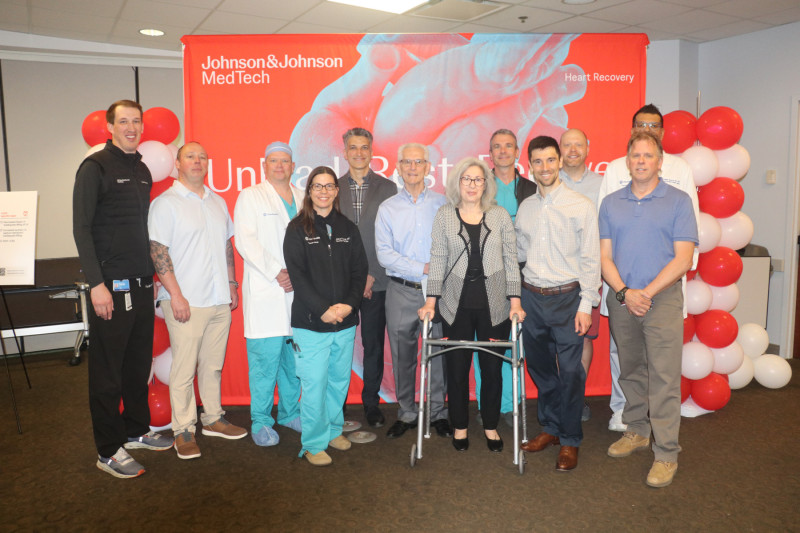 On April 15, LaMonte returned to Riverside to reunite with the EMS and hospital teams who saved his life.
“It was a little bit overwhelming, I’m just so grateful to them, I’m grateful to them because I know they all did a terrific job,” LaMonte said.
“Seeing mark and his family reminds us all as to why we do this,” Dr. Phillips said. “And it also reinforces our determination to push the envelope with respect to extreme care in patients who have no options. We don't often get to hear from the patient regarding their experience and what it meant to them to receive the care that they got and how it affects not only the patient but their family as well.”
Dr. Phillips said the reunion was emotional for him.
“Sometimes we get lost in the day-to-day minute of what we do and it's days like this are opportunities like this that allow us to reconnect with our mission which is to serve our community,” Dr. Phillips said. “In behind every stent and heart catheterization is a patient who's a father, brother, husband or son and that's really important and we can never lose sight of that.”
He added that it takes a coordinated team to care for patients in critical situations like LaMonte’s.
“The work that we did acutely in the catheterization lab is a large part of why he survived, but he would not have survived without the care he received initially from the EMS team as well as our emergency room physicians, and then the efforts of nurses and Cath lab personnel and the ICU physicians as he recovered. One physician or team alone cannot fully treat a patient like mark, nor would he have survived without all the people that contributed to his care,” Dr. Phillips said.
“It is always rewarding to see these patients back in the office, after they have endured the most invasive level of life support (ECMO), and they had a meaningful recovery,” Dr. Enlow said. “The families have been through so much emotional and physical hardship to get to that point. Mark was especially unscathed by that level of support, and he is very educated and aware of what he went through, and he is genuinely grateful. It makes it worth it.”
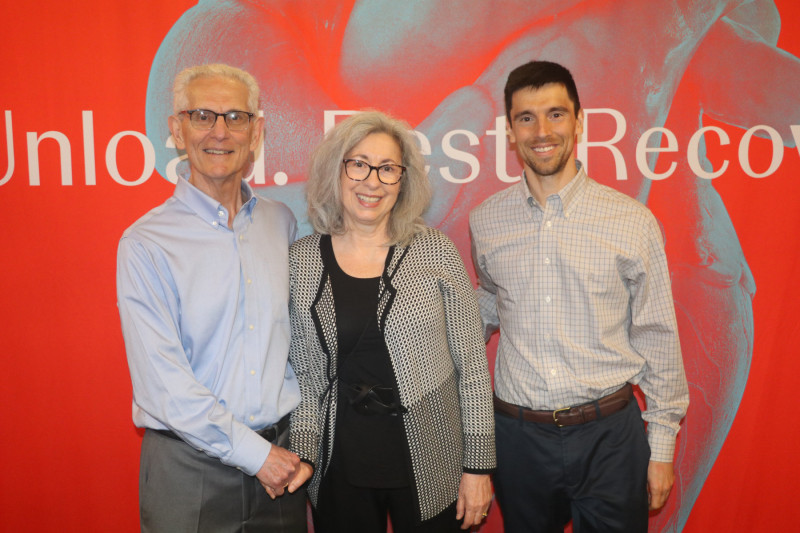 LaMonte shared that his wife and children are his world and really helped him throughout his recovery. “They were there always, they’re like my rock, my whole family,” LaMonte said.
He continues to express deep gratitude for the EMS team and care teams at Riverside.
“The reason I’m standing here talking to you today, that’s what the miracle is, it’s a miracle of their efforts,” LaMonte said.
Hospital leaders say LaMonte’s case reflects the strength of a highly experienced team.
“We are fortunate at Riverside to have skilled staff at every level that are involved in complex cases daily in a very high-volume setting,” Dr. Enlow said.
“Personally, one of the most things that I am proud of here at Riverside Methodist Hospital is the expertise of the physicians, staff and the professionalism that was on display during marks initial treatment and then the care that he received subsequently," Dr. Phillips said. "And this is just my opinion, but if he had gone to any other hospital in central Ohio, perhaps even the state, he probably would have died. We have a remarkable team of experts who are world renowned right in this community.”
