

Runner Returns to OhioHealth Capital City Half & Quarter Marathon After a Stroke During 2024 Race
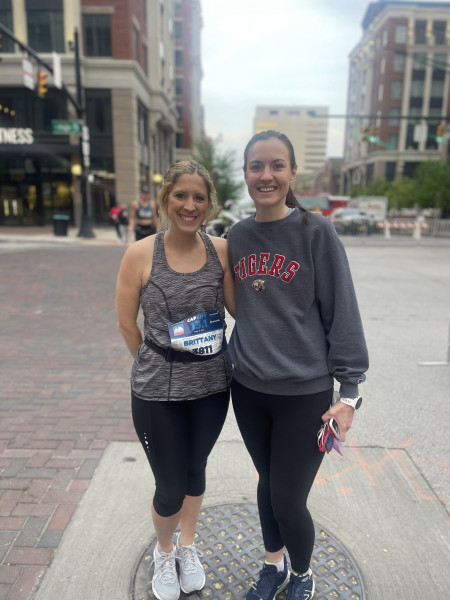 As the race’s medical partner, OhioHealth will have a full medical team on April 25, 2026, positioned along the course and at the finish line to care for spectators and runners participating in the OhioHealth Capital City Half & Quarter Marathon.
When runners line up each spring for the OhioHealth Capital City Half & Quarter Marathon, they prepare for months to complete the 13.1-mile course through downtown Columbus. For one runner, the 2024 race became the beginning of a life-changing medical emergency, and a story of resilience.
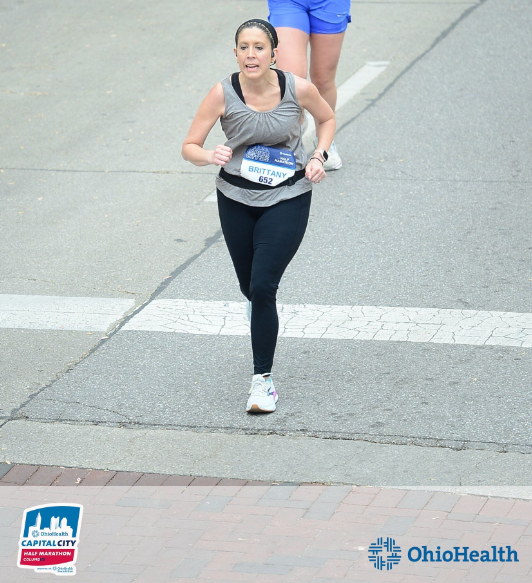
On April 27, 2024, Brittany Garner arrived downtown ready to run her third Capital City Half Marathon. Instead, she began experiencing symptoms that would later be diagnosed as multiple strokes.
“I anxiously traveled to my running corral when I felt a horrible pain in my neck and the back of my head after using the restroom,” Garner said. “Suddenly I became dizzy and confused but thought that maybe I twisted my neck in the bathroom before the race.”
Despite feeling disoriented, she decided to continue. Ironically, she ran into a neighbor and had her rub her neck in an effort to relieve what she thought was a strain.
“After an attempt to text my husband and friends that something was not right, the race began and I started what would be a very traumatic journey to the finish line,” Garner said.
As the race continued, the symptoms worsened.
"I can’t remember everything about this race due to trauma and stress of the event, but I do remember several big events along the course of the race,” Garner said. “After the race started, I continued to feel dizzy and unsteady the first several miles, but I was able to continue running at this point.”
When she got to the first water station, she remembered water dripping down her face when she tried to drink out of the small dixie cup. For Garner, this was alarming and an unusual experience from the dozens of other runs she’s participated in over the course of her running career. Soon after, she began losing coordination along the course.
“I remember running into a parked car and several trees,” Garner said. “I remember a group of spectators helping me off the ground several times as I ran off of the road into the curb-each time assuming I was just tired and not prepared to run the race I had set out to run.”
Even as she struggled, she pushed forward.
“Something inside me told me that I should end my race early,” Garner said. “But I am not a quitter and decided that I had to try to finish what I had trained over four months for.”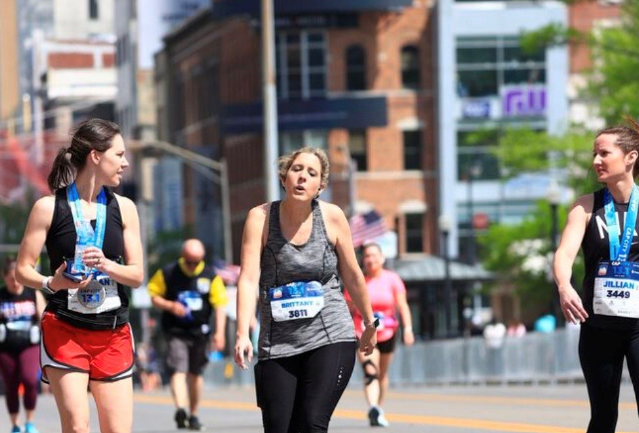
After more than three hours of running, walking and stumbling, friends helped guide her through the finish line.
“My friends found me with about a half mile left and walked me through the finish line just like you’d see in a movie,” Garner said. After the race, her speech was slurred and difficult to understand. Later that evening, with symptoms still present, she decided to go to the emergency department at OhioHealth Dublin Methodist Hospital. While waiting, she looked up her symptoms online.
“I googled my symptoms only to see the suggestion that my symptoms mimicked that of a stroke,” Garner said. “I thought to myself that there was no way that someone like me could suffer a stroke. I was young, healthy, a non-smoker, who lived a lifestyle that had no risk factors for stroke.”
Aaron Loochtan, DO, OhioHealth vascular neurologist, said strokes can occur in anyone, including young, healthy and highly active individuals. Although, the risk is higher among people with conditions such as high blood pressure, high cholesterol, diabetes, obesity or genetic or heart-related disorders. He said structural heart problems, irregular heart rhythms or clotting disorders can also increase stroke risk.
Dr. Loochtan noted that extreme physical or mental stress can sometimes trigger a stroke, particularly if there is an underlying medical condition.
“High-level athletes usually have well-conditioned hearts and other organs and those sorts of things,” he said. “But if there is something wrong with the heart that we don’t know about and we put the body through repeated or intense stress, that can increase the risk of a stroke event.”
After testing was done in the emergency room, Garner was transferred by ambulance to OhioHealth Riverside Methodist Hospital for further evaluation.
“After several CT scans and MRIs, I would learn that at the age of 35, I had indeed suffered three significant strokes in my cerebellum and occipital lobe,” Garner said.
Dr. Loochtan explained that what are often described as “mini strokes” are typically transient ischemic attacks or small clots that travel through the bloodstream and affect multiple areas of the brain at once. In these cases, patients may experience symptoms that appear in different parts of the body even though the event is related to a single clot.
“What’s happening is they’re having the same stroke occur all at the same time, but in different areas,” Dr. Loochtan said.
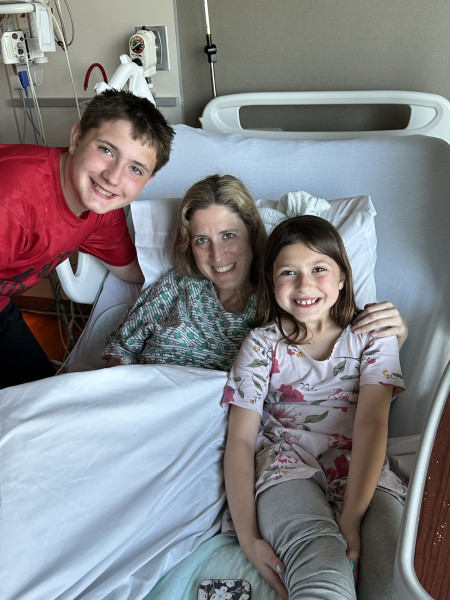 For Garner, the diagnosis brought back memories of losing her mother unexpectedly as a child.
“My mother had died unexpectedly of a brain tumor when she was 38 years old,” Garner said. “For a second, my 11-year-old self-flashed before my eyes as I realized that my children could have lost me.”
She spent three days in the hospital’s neurology unit following the diagnosis.
Doctors did several tests but did not find common stroke risk factors such as heart conditions or clotting disorders. Though the cause is still not known for certain, Garner said it was suspected to be a combination of birth control medication, and a history of migraines that could have contributed to her strokes.
Garner was placed on daily aspirin as well as a statin to reduce stroke risk. She will be on this preventative medicine her entire life.
After leaving the hospital, Garner spent six to eight weeks in speech, physical and occupational therapy.
“I walked with a labored gait on my left side and could not walk in a straight line due to balance issues,” Garner said. “Word finding was difficult initially and I would mix up words.”
In addition to physical recovery, she worked through the emotional impact of the experience with a psychologist specializing in medical trauma. Today, she says she has nearly fully recovered.
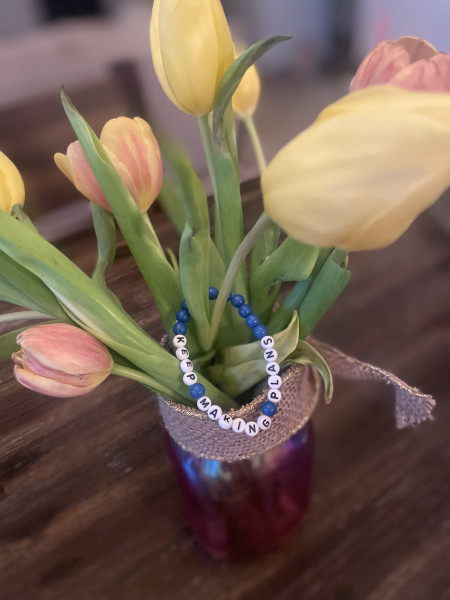 During her recovery, a bracelet from OhioHealth with the phrase “Keep Making Plans” became a meaningful reminder. She received the bracelet in her 2024 race packet prior to running the race that changed her life forever. She tossed it to the side not realizing what it would mean to her once she got home from the hospital.
“No matter what life throws at you, medically or otherwise, keep making plans,” Garner said. “My medical event was not a death sentence. It was an invitation to keep living life to the fullest.”
In 2025, one year after her stroke, she returned to run the OhioHealth Capital City Half & Quarter Marathon.
“In fact, I ran my fastest half marathon time ever the year after my stroke, beating my second fastest time by 15 minutes,” Garner said.
She set four goals: participate safely, finish the race, complete it without stopping and set a personal record. She accomplished all four of those goals.
“I had so much trauma attached to the race and so many horrible memories from 2024,” Garner said. “I was determined to run again and make new memories.”
Garner is returning to Cap City this year to “have fun” and to remind herself and others to “keep making plans.”
The starting line to this race is further evidence that I am stronger than my stroke,” Garner said.
While stroke recovery varies by patient, Dr. Loochtan said the goal is to help patients return to normal activity when possible. He said many stroke patients do not fully return to their previous level of function, but recovery outcomes have improved with therapy and coordinated care. Garner represents an ideal outcome.
“That’s our goal, that’s the best outcome we could have, we’re very proud of her and we’re very happy for her,” Dr. Loochtan said. “We want people to not be afraid, we want them to keep on doing things, being as active as they can and getting them back to normal.”
Dr. Loochtan credits first responders, emergency medical staff, nurses, physicians, imaging technicians, laboratory staff, therapists and social workers for supporting stroke patients from the moment of emergency response through outpatient rehabilitation.
“It really takes an army,” Dr. Loochtan said. “We couldn’t do this alone, everybody is a part of the team and it makes us very proud and very happy when it all works, we have successful outcomes like this.”
Garner now encourages others to pay close attention to their bodies.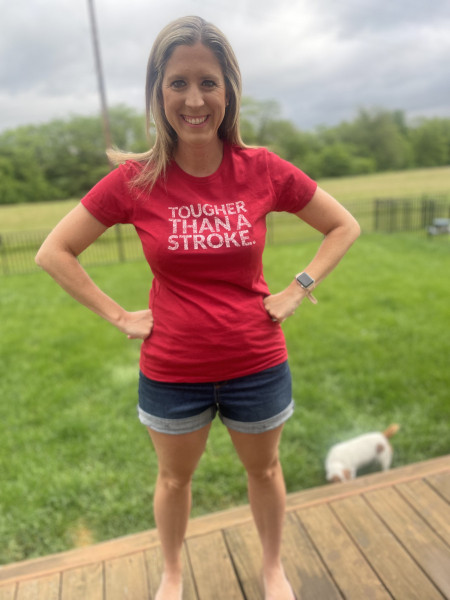
“No one can evade all illness,” Garner said. “Our bodies are amazing, but they can fail us at times.”
She urges people to listen to warning signs and seek medical care even if symptoms turn out to be nothing. During a health scare, she also emphasized the importance of leaning on loved ones and following medical professionals’ recommendations for treatment and rehabilitation.
For those who are participating this year or hope to in the future, “Don’t ever count yourself out- at any age or any health stage. Everyone is running their own race, figuratively and literally.” Garner went on to say, “Even if you face adversity, whether it be something like a stroke or cancer or an injury or mental illness- use these setbacks to make you stronger. Do not let your illness or injury define you. Come back stronger than ever.”
As the race’s medical partner, OhioHealth will have a full medical team on April 25, 2026, positioned along the course and at the finish line to care for spectators and runners participating in the OhioHealth Capital City Half & Quarter Marathon.
