

“What Matters Is What’s Best for the Patient:” OhioHealth Mansfield Hospital Completes 300th TAVR Procedure Using Patient-Centered Approach
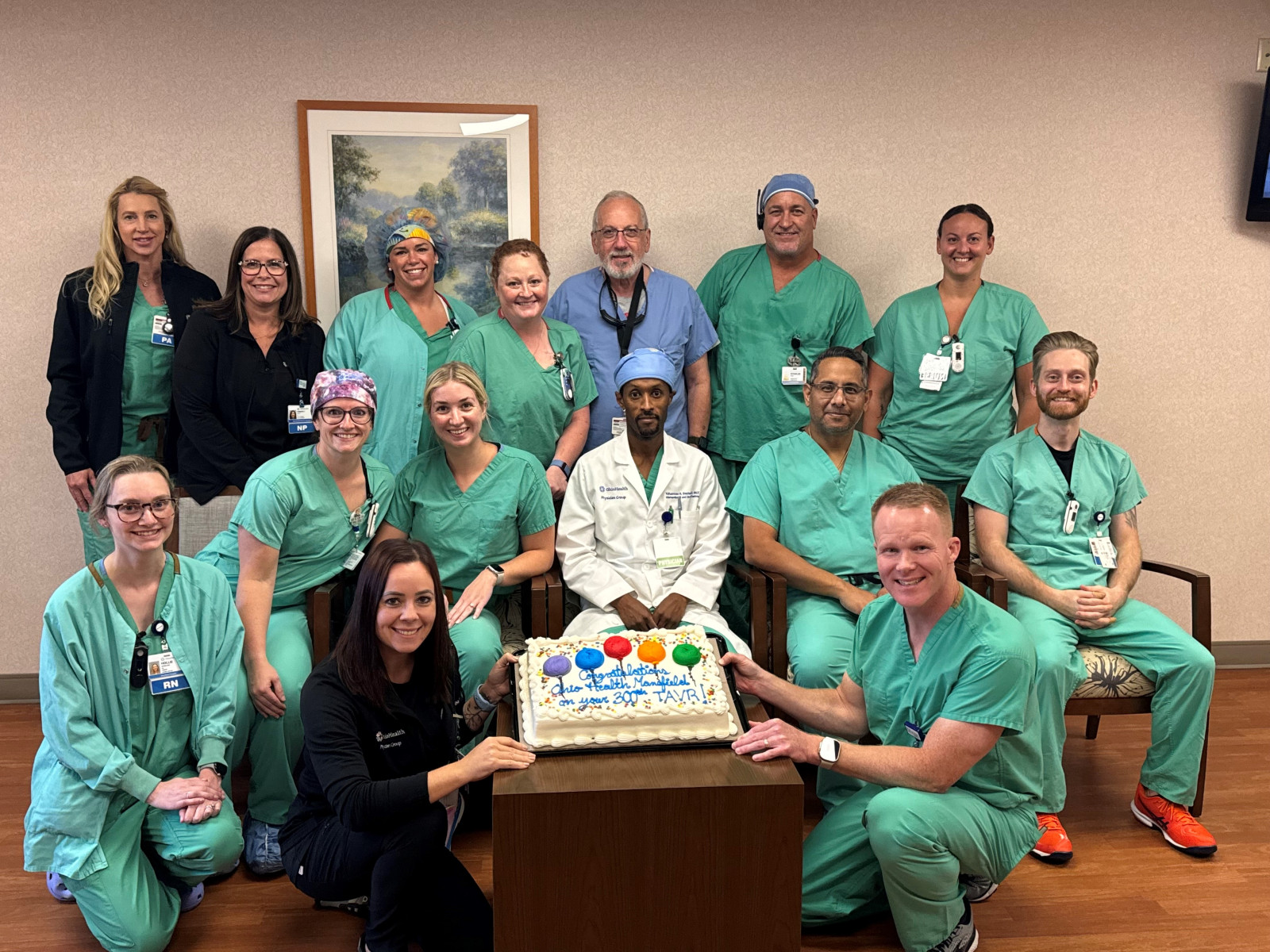
A less-invasive procedure to replace a heart valve is changing patients’ lives in Mansfield and the surrounding area. “I was just totally surprised when I could have this,” said 86-year-old Janice Smith, an OhioHealth Mansfield Hospital patient and Transcatheter Aortic Valve Replacement recipient. “…I had the TAVR and it was overnight and I didn’t have a lot of recovery with that. I was very, very pleased that I had the opportunity.” Smith is one of hundreds of Mansfield Hospital patients who’ve received a TAVR in North Central Ohio. Still, it’s a procedure most people don’t know exists.
A Transcatheter Aortic Valve Replacement, or TAVR, is a procedure to replace an aortic valve that has narrowed without opening up the chest. Instead, it involves a small incision and a hollow tube called a catheter to reach the heart. While many people are still unfamiliar with it, the TAVR has been offered at Mansfield Hospital since 2020. In fact, the hospital’s Structural Heart Team just completed its 300th TAVR procedure last month. “To get to 300 in four years, it’s a slow progress, but a working progress,” said Structural Heart Medical Director Yohannes Bayissa MD. “It’s a working progress because we’re still educating people and primary care offices. A lot of doctors don’t even know the procedure is offered here.”
Mansfield Hospital has two cardiologists who perform the TAVR procedure- Dr. Bayissa and Atish Mathur MD. The TAVR itself requires both surgeons, but anyone on the Structural Heart Team will tell you the process to get to the operating room involves an entire team. “At the end of the day, what matters to us is what’s the best thing for the patient now,” said Dr. Mathur. “What’s the best thing for the patient 10-15 years from now. So, we have to think about what I can do for him or her today, what can I do for this person who’s going to come back to me in 10-15 years. That requires a lot of planning and thinking and discussion. It’s all a heart team discussion with the medicalists doing an in-depth, deepest analysis possible of the images that we have in order to decide what’s best for the patient. And that’s the heart team approach.”
That heart team approach has brought the Structural Heart Program a long way. According to Dr. Mathur, a TAVR patient hasn’t had to go to the operating room to be saved during the procedure in more than three years. That statistic, as well as research showing TAVR results to be just as good as open-heart surgery, put patients like Smith at ease. She already had open heart surgery 14 years ago. Last year, she needed her aortic valve replaced again, but at 85-years-old at the time, she was a better candidate for the less-invasive procedure. “It was so much easier,” said Smith. “I wasn’t on a lot of pain medication. Things just went faster. My kids kept saying, ‘Are you sure you’re ok staying just one night?’ Because they had been involved with the first surgery and knew I was in (the hospital) for quite a few days.”
Whether a patient is a better candidate for open-heart surgery or the TAVR is a decision the Structural Heart Team will make together. After four years of performing the surgery, Dr. Bayissa says the team has become faster and more efficient. And they’ll continue to do so, being the only hospital in the North Central region to offer the procedure locally.
