

Woman with Rare Digestive Disorder Finds Pathway to Recovery at Mansfield Hospital
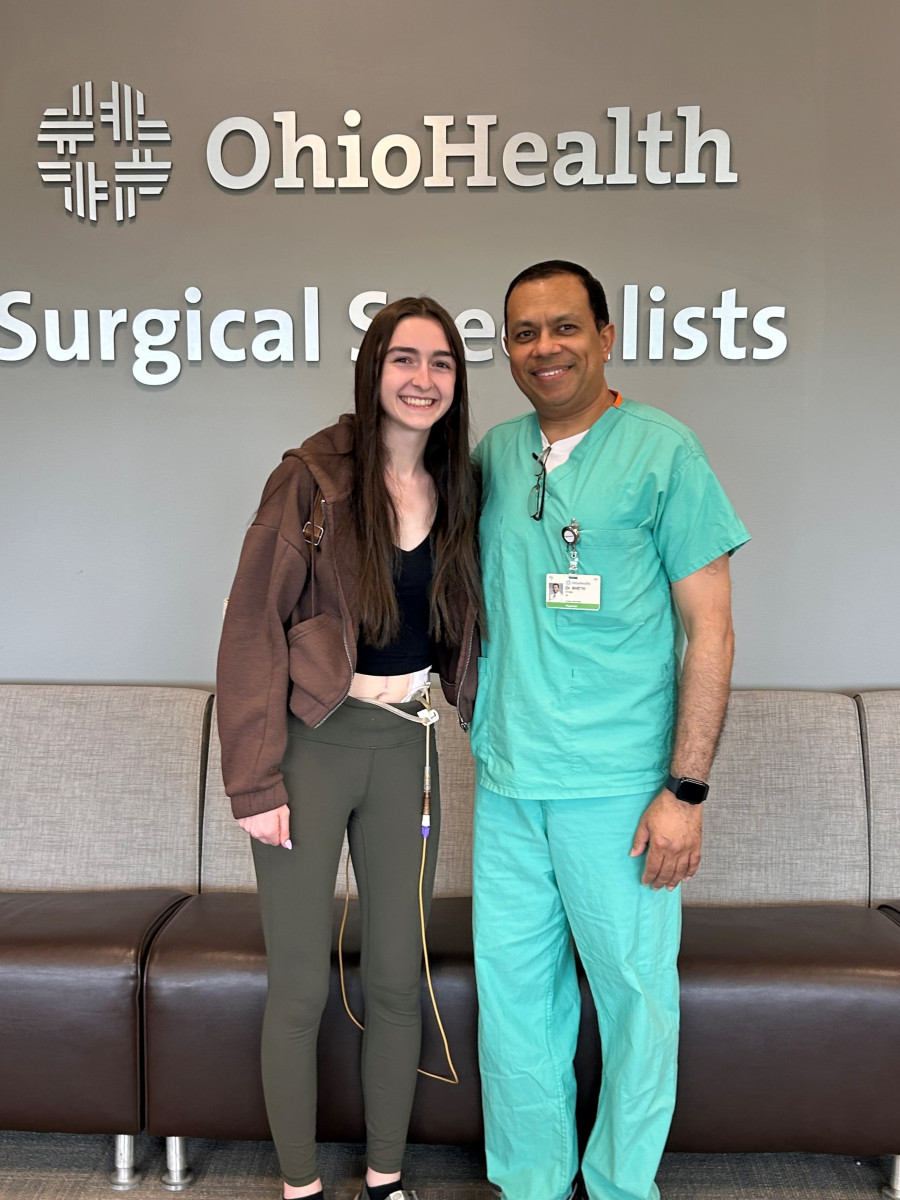
A young college student at Ashland University is recovering, after receiving an incredibly rare diagnosis last year. In May 2024, Reese Vance began experiencing constant vomiting, extreme weight loss and dehydration. The symptoms were so extreme, she was forced to miss classes and eventually take a break from school. By December 2024, she had taken 36 trips to the emergency department.
"One time right before a test I was going in to take, I actually threw up in the parking lot. Toward the end of the spring semester, when I was close to finals, I started to get really, really sick and so I started missing classes,” Vance told Zach Tuggle at Mansfield News Journal.
Her illness was originally misdiagnosed as food poising, but later correctly identified as Superior Mesenteric Artery (SMA) syndrome by Dr. Piyush Sheth, MD, General Surgeon at OhioHealth Mansfield Hospital. The National Center for Biotechnology Information describes SMA as a rare disease where the third portion of the duodenum, the final part of the small intestine, is compressed, blocking food from passing through.
This caused her to throw up food and water, leading to extreme dehydration. "I would dehydrate so quickly to the point where I would be so dizzy and delirious," Vance said.
The severity of her symptoms led her mom, Summer Hunsinger, to take time away from her job. "I stopped working," Hunsinger said. "I would not leave her side."
They also decided to temporarily take Vance out of classes for the 2024-25 school year, so she could focus on her health. For eight months, Vance was left scared and confused without any answers. She lost 50 pounds throughout these months, losing the ability to get proper nourishment in her body.
"If you lose a lot of weight very quickly, the fat surrounding the arteries and the fat surrounding the intestine, those fat cells shrink down," Dr. Sheth said. "And as they shrink down, the two arteries get closer and they obstruct the intestine."
When SMA is left untreated, it becomes increasingly more difficult to treat. Dr. Sheth said his goal when treating Vance was to avoid performing invasive surgery that would alter her quality of life in the future.
"The treatment for this, theoretically, would be to cut the intestine as it goes between the two arteries, take it around the arteries and hook it back together," Dr. Sheth said. "Because of the rich blood supply there, that surgery is never recommended. It's possible, we just don't ever do it."
Keeping in mind how aggressive a bypass can be, Dr. Sheth had to decide what the best treatment plan would be for her. Vance now has two tubes inserted in her to help deliver nutrients to her body and release pressure built-up in her stomach. The tubes have already helped to improve her symptoms and allowed her to gain some of the weight back.
"She has turned the corner. She's gaining weight," Dr. Sheth said. "She's even able to eat some stuff and did not have to be drained out from her stomach. It's passing through her intestines."
They plan to remove the tubes once her body can withstand food normally without needing to drain anything. While Vance and her mom worry the condition may return in the future after removing the tubes, they trust Dr. Sheth’s expertise.
Vance said the care she received helped to ease her pain and worries throughout the grueling process. "I don't think I could have trusted another doctor as much as I trusted Dr. Sheth," Vance said. "He would come see me every day. It's like he's my new grandpa."

