

OhioHealth Supports Sustainability With Shift in Nitrous Oxide Delivery
Nitrous oxide. It’s a critical anesthetic used every day for pain relief and sedation in operating rooms.
“Nitrous oxide, known as laughing gas, is one of the oldest anesthetics, it works fantastic,” Shawn Cuevas, DO, OhioHealth Grady Memorial Hospital anesthesiologist, said.
“It is unique in that it is centrally supplied,” Hameed Salah, DO, OhioHealth Doctors Hospital anesthesiology resident, said. “We have these huge tanks in a storage room that are connected all together and are piped all throughout the hospital to each operating room.” From there, during surgery or a procedure, the anesthesiologists can provide nitrous oxide to patients.
While effective, centralized nitrous oxide systems can lead to significant waste each year. And beyond the hospital walls, those emissions come at an environmental cost. Nitrous oxide has 265 times the global warming potential of CO₂.
“Conversely, it is a very potent greenhouse gas which has a significant effect on climate change, unfortunately, it hangs around for over a century,” Dr. Cuevas said. “Is nitrous oxide the sole contributor to global warming, absolutely not, but should citizens do what they can to help, I think so.”
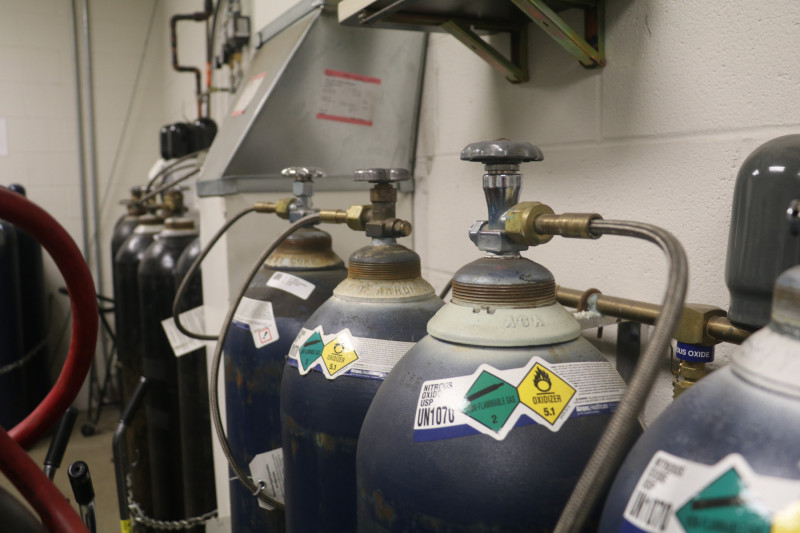 OhioHealth is working to decommission centralized nitrous oxide piping as part of its broader sustainability efforts.
“At OhioHealth, we believe we decide the future today and that’s what we look at through our sustainability program to make sure we’re building the healthiest, safest care system to deliver care not only in Ohio but in the nation,” Terri Scannell, OhioHealth principal advisor of sustainability, said.
The goal is not to remove the usage of nitrous oxide completely, but rather to change how it’s delivered.
Instead of large, centralized systems, OhioHealth is transitioning to small e-cylinder tanks placed directly on the back of anesthesia machines.
“We’re still able to provide nitrous oxide and keep that as an agent our anesthetic providers can use, without the waste,” Dr. Salah said.
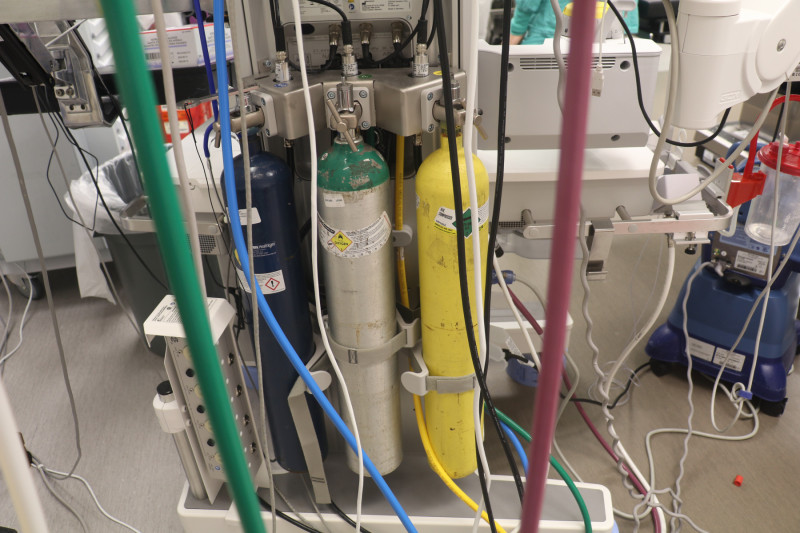
At Doctors Hospital, that transition is already underway. Over the past year, Dr. Salah has helped lead a pilot study there.
“We had the opportunity to present our overall project, our pilot study to our anesthesia providers, and we talked to them about what is the goal,” Dr. Salah said. “Providers would have the e-cylinders open at all times, so whenever they wanted the nitrous oxide, they would be able to use it.”
If for any reason, providers and team would need to hook back up to the centralized piping system, they’d be able to. According to Dr. Salah, there has not been one single safety event noted in the entirely of the pilot study.
Just this month, OhioHealth sustainability and other organization hospital leaders visited Doctors Hospital to see the system in action and learn more about how the transition works in a real clinical setting.
Doctors Hospital is now the second care site in the organization to make the switch. Grady Memorial was the first, launching a six-month pilot program in 2024 led by Dr. Cuevas.
“At that point, there had been multiple systems in the country that had been talking about the gains that they had received from cutting nitrous oxide use,” Dr. Cuevas said. “We created a pilot study, here at Grady Memorial, we opted to take an incremental approach, we did keep our pipeline open, but we disconnected our anesthesia machines for what we determined to be a trial period.”
Meaning, they did not limit the use of nitrous oxide, they did not limit patients receiving nitrous oxide but instead utilized the e-cylinder tanks instead.
“Our feasibility project was successful, and at that point we started having discussions about turning this feasibility into a long-term solution,” Dr. Cuevas said.
For many involved, the shift is about more than efficiency - it’s about the connection between environmental responsibility and patient health.
“Taking care of the environment is part of healthcare, my patients have to go home. We all live on this earth,” Dr. Cuevas said. “Obviously, there’s going to be waste associated with everything but doing common sense things to make our environment better, which our patients live in, makes sense.”
Now, the focus turns to expanding this work across the system.
“I’ve made sure that the docs, nurse anesthetists that I work with are prepared to continue to provide excellent care with this different type of model, and now it’s going to be pushing it into the hospitals, slowly figuring out how to properly shut down these [centralized] systems correctly and in a safe way and in a sustainable way and push it forward,” Dr. Cuevas said.
As the effort grows, Dr. Cuevas says collaboration across teams has been key to moving the work forward.
“I have to give kudos to the project leads, sustainability really has driven this,” Dr. Cuevas said. “With that being said, they highlight us as clinicians but it’s them that’s bringing us together and leveraging the clinical skills versus the clinical support teams and making sure that we get all the stakeholders at the table together to help push this initiative.”
He adds that support from dedicated OhioHealth sustainability experts, along with strong organizational engagement is what’s making that progress possible.
“OhioHealth has been leading in sustainability, and I think that’s demonstrated by our sustainability staff,” Dr. Cuevas said. “I think it’s easy to make pronouncements but investing in professionals and those professionals having the skills to bring all the rest of the team at OhioHealth together around a goal, without our sustainability staff, we just wouldn’t have the know-how to get all this stuff together to get things done.”
“At OhioHealth, we’re very fortunate, we have leadership who are engaged as well as grassroots, so sustainability is woven throughout our whole organization,” Scannell said. “We actually only have two sustainability folks, but we’re able to be one of the best sustainable healthcare systems in the nation because we have so much engagement.”
OhioHealth is the only hospital in Ohio to have The Joint Commission sustainable healthcare certification.
