

OhioHealth Surgeon First To Introduce Thumb Implant in Ohio
According to OhioHealth orthopedic surgeon Stephen Berling, MD, thumb arthritis is the most common type of surgically treated arthritis in the hand. Thumb carpometacarpal (CMC) osteoarthritis is a debilitating condition that effects millions of Americans and can dramatically impact hand use and quality of life.
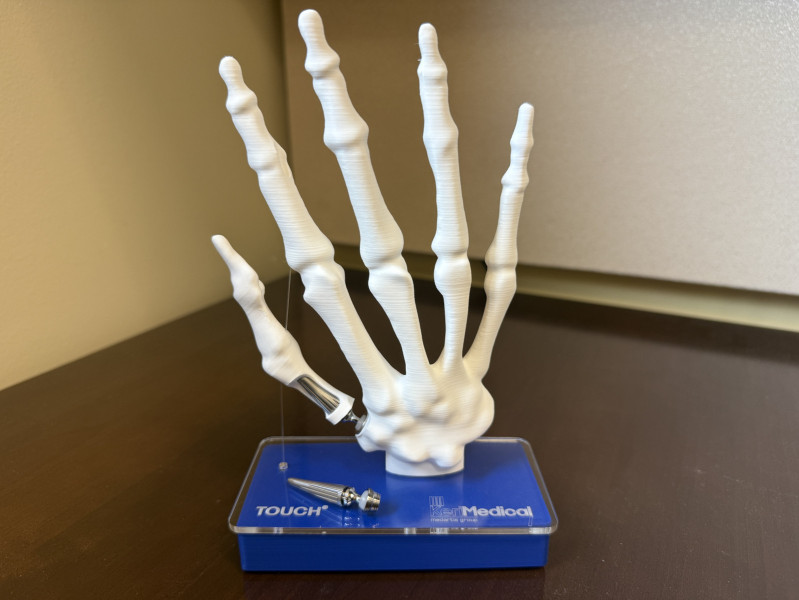 A thumb implant, used more than 130,000 times in Europe, is now being performed in the United States after receiving FDA approval last year. Dr. Berling was among a select group of surgeons trained to perform the procedure and one of only a few from Ohio. In May, he was the first surgeon in Ohio to implant the TOUCH CMC 1 Prosthesis.
“If this continues to have the trajectory that it does, this will be the standard of care for thumb replacement surgery, not the way we’ve been doing it for the last 50 years which I think could be a dramatic paradigm shift in hand surgery that is going to be great for the entire system and city far and wide,” Dr. Berling said.
The first U.S. implant was performed in Aurora, Illinois. Training later expanded from a small group of surgeons in Europe to a group of U.S. surgeons in Las Vegas, where Dr. Berling was trained alongside surgeons from Cincinnati and Cleveland.
“It is a two day excursion where training surgeons get to meet with the design team and practicing surgeons to go over every aspect of the implants and the thought process behind them,” Dr. Berling said.
Dr. Berling and the other surgeons in training then met with two French surgeons who had been performing the procedure for nearly 10 years. The Swiss-designed CMC Touch 1 prosthesis was developed and manufactured by KeriMedical and distributed by Medartis Inc in the US.
“It’s one thing to watch a video of it, but it’s another thing to talk and sit with someone as they’re performing the surgery, and then you sit down with the cadaver and do as many as it takes to feel comfortable doing the implants,” Dr. Berling said.
The implant does not require any anatomy changes. Surgeons use the same approach they are already familiar with; the difference is in the mechanics of the instrumentation.
Dr. Berling describes the implant as a mini hip replacement for the thumb and performs the surgery at OhioHealth Doctors Hospital.
“The mechanics of it are a ball and socket joint to replace the saddle joint that is your thumb,” Dr. Berling said.
Traditional thumb reconstruction is used when bone-on-bone arthritis occurs where the thumb meets the wrist. The procedure involves removing the trapezium bone and then resuspending the thumb. “Essentially, you’re using your own tendonor suture anchors to then reconnect your thumb back to your index finger so that your thumb its normal motion.”
One downside of traditional procedures is that the thumb may take time to function properly without the bone, which can lead to a lengthy recovery of six to nine months. Patients after traditional thumb arthritis surgeries are in a splint or cast for 6 weeks, while patients who receive the TOUCH prosthesis are leaving the operating room with just an ACE bandage.
“I tell people it could take in the neighborhood of six to nine months for your thumb to feel like your thumb again,” Dr. Berling said. “You’re retraining muscles to compensate for the fact that your bone is not there, and you’re trying to use the same motion to get the same pinch.”
With this new implant, the bone is not removed, which provides immediate stability and helps accelerate recovery. The outpatient surgery takes about 45 minutes, allows patients to go home the same day and can be performed under twilight, nerve block or general anesthesia. Stitches stay in for two weeks, and once they are removed, patients can shower and get their hand wet.
“People are coming in at two weeks or three weeks after surgery with the same motion that I would previously expect at four to six months, with almost no pain whatsoever,” Dr. Berling said. Dr. Berling recommends that patients avoid heavy lifting for six to eight weeks, but they can resume normal daily activities.
“One of Dr. Berling’s patients, Julia Brown, told NBC4, ‘It’s remarkable when you can wake up and be pain-free in a certain part of your body where you have pain in other parts. That just gives you a lot of hope.’”
The implant also helps restore pinch and grip strength while maintaining the length of the thumb without removing the bone.
To qualify for the implant, patients with thumb arthritis typically must first fail conservative treatments. The implant does not replace options such as bracing, therapy and injections, which can provide lasting relief and often help patients avoid surgery.
Like any joint replacement, the implant can wear out over time, but Dr. Berling expects for most patients that this implant will last the rest of their life. Patients whose jobs place heavy manual demands on their hands may not be ideal candidates. However, people who are active, use their hands and thumbs regularly, work out or bike or play pickleball can still be good candidates, and those activities are not expected to cause the implant to wear out quickly.
As technology and health care continue to evolve, OhioHealth and its experts remain focused on finding new ways to improve patient care. “We’re never satisfied with how things are going, there’s always room for improvement,” Dr. Berling said.
Dr. Berling explained that thumb surgeries have been done the same way for 60 years, but newer approaches may help improve outcomes using methods that have already been proven effective.
“This new generation of thumb implants are working because we have been able to use the same technology that has improved knee and hip replacements and translate them to the thumb,” Dr. Berling said.
To view the NBC4 story, click here.
